Search
Random Recipe
All Day Breakfast - Let’s talk Sausages.

There are thousands of Sausage variations, you only need to set foot in your local Polish Deli to realise that. But in the UK there are two distinct styles.
(1) The generic Smooth Sausage.
(2) The courser grained Traditional Sausages which are to be seen on the counters of more artisan Butchers.
Both styles can be flavoured with various Herbs and Spices to make the likes of Lincolnshire, Cumberland, Pork & Leek, Hot Chilli etc. But essentially the difference in style is in the way they are made. It is also visible in the price of the resulting Sausages.
When I initially worked at the butchers some years ago their Sausages were all the smooth kind. There’s absolutely nothing wrong with them and I quickly learned how to mince, season, extrude and link them. But as I soon learned there are three main differences from the courser grained style.
(1) Mincing process.
(2) Seasoning content.
(1) Water content.
For a small batch of the smooth style sausages you would typically mince 10kg of boned out Pork shoulder. Add a whole pouch of seasoning mix and 3 litres of water. Then mix well and feed the whole mix through the commercial mincer again. This is then loaded into the extruder and extruded into casings and linked into Sausages. The resulting sausages are very soft in texture but after a couple of hours in the walk-in fridge they will have swelled and set. They are then good to cut up and display on the counter.
One morning when I went in I found my counter was stacked high with boxes of Pork Shoulder. I opened the walk-in fridge to find it was absolutely full. Having put my pinny on and stuck my head through the chains I found Geoff dressing the display counter and muttering various profanities. “Morning Geoff, what with the monster delivery?” - “Bloody Barry fell for the sales patter, I’ve no idea what we’re going to do with it all and he’s hiding from me!” I’m not sure Barry was hiding to be fair, he was probably just sleeping. It was 4.07am after all!
I suggested that I might make a few batches of Traditional Sausages and we could sell them as a special. Geoff basically said “ Fill your boots if you think you can link them!” So I dug out a previous mistakenly ordered box of Traditional Sausage seasoning and casings and set to work.
The process was outlined on the seasoning pack and was quite different. Basically you mince the Pork shoulder once, add the seasoning mix and combine everything with 500ml of water by hand. The seasoning pack doesn’t have rusk or Carmine colouring in it. So you end up with a very firm mix to bundle into the extruder. At this stage I began to worry. Would I be able to get this consistency of mix to extrude and link without bursting the ‘Skins’ - casings? As it happens the casings for Traditional style Sausages are .006 grade rather than .004 grade for smooth Sausages. So the extruding into the casings part went reasonably well, even though the extruder made various sounds of complaint and the motor smelled of overheated windings…. Linking them was very slow as I had to nip the casing between my thumb and forefinger for each twist because the filling would not move freely within the casing. But I did it! 90Kg of Sausages in various flavours in the the single mince Traditional style were dutifully hung in the walk-in fridge. Boxes flattened, counter cleaned, extruder and mincer stripped and cleaned.
As there is no Carmine colouring in the mix they look a bit less artificially pink and more meat coloured, so I moved some bits and bobs about of the chilled counter and used the Bacon to separate the Smooth style from the Traditional style. Geoff actually gave me a pat on the back and a nod of approval – a very rare and appreciated gesture.
I priced them at 30% by weight above their smooth cousins and hoped for the best.
Two weeks down the line we were selling 65 / 35 by weight Traditional / Smooth and our restaurant customers had all asked to switch! I also didn’t get stabbed and fed through the mincer - Which is good!
On Facebook
- Details
- Written by Tony Carson
- Category: Recipes


- Details
- Written by Tony Carson
- Category: Recipes
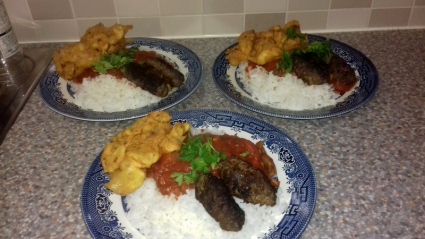
- Details
- Written by Tony Carson
- Category: Recipes

 For the Chicken marinade
- Details
- Written by Tony Carson
- Category: Recipes
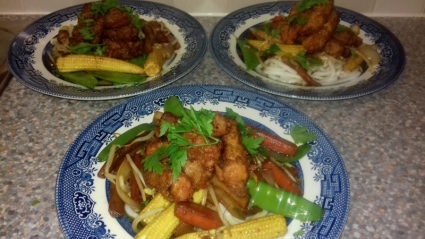
- Details
- Written by Tony Carson
- Category: Recipes
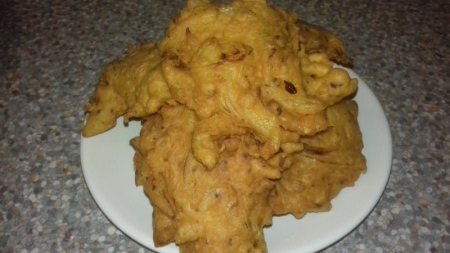
We actually cooked far too much Turkey curry on Tuesday so we had left overs yesterday. With a addition of a fresh batch of Onion Bhajis
Social Links
Translate

Latest Recipes
Latest News
- Why do we do what we do?
- When you find the ships cat on the helm
- We're a month old!
- Universal Credit & Employment Agencies!
- UN Report on Poverty in the UK November 2018
- The Veg Box
- The rollout of Universal Credit will be delayed until 2023
- Petition the Government to fix Universal Credit
- Honesty from a Politician? Not really, but it's a start.
- Homeless - Trapped - Homeless again - This can't be right?
© 2026 Eat Well on UC